
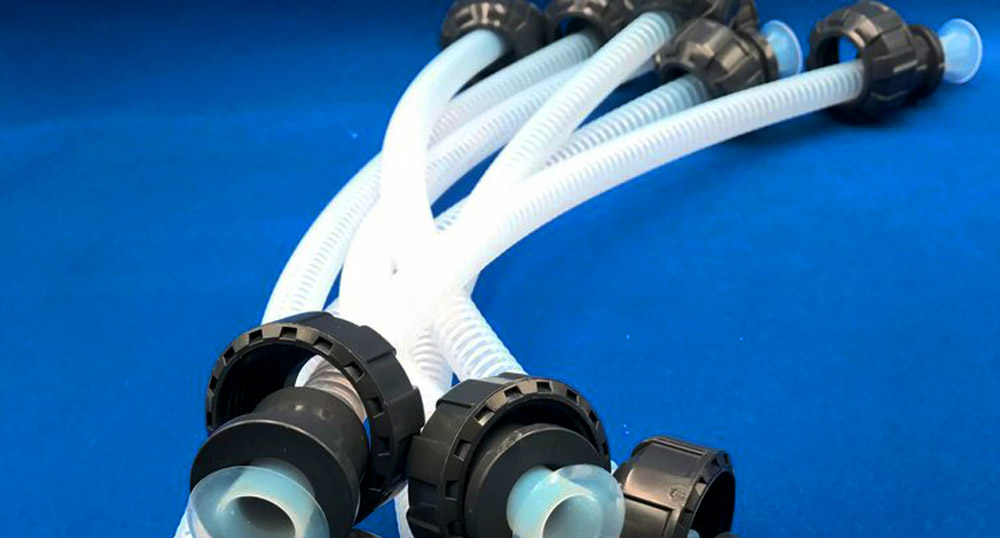
PTFE tubing is a tubular insulating material made from polytetrafluoroethylene (PTFE). Thanks to its unique molecular structure, it offers excellent heat resistance, corrosion resistance, and high insulation performance. The fluorocarbon molecular structure effectively resists acid and alkali erosion, while the flexible tube body easily adapts to complex wiring configurations, significantly outperforming rubber and PVC materials. Certified by international standards such as SGS and UL, PTFE tubing has become a critical component in industrial insulation applications.
1. Core Advantages
Polytetrafluoroethylene (PTFE) is a polymer material composed of carbon-fluorine bonds, in which fluorine atoms tightly surround the carbon chain, forming a highly stable chemical structure. Compared to traditional rubber or PVC insulation tubing, PTFE tubing offers a wider temperature resistance range (rubber typically supports only -40℃ to 105℃), superior chemical stability, and greater resistance to aging caused by environmental factors. Compared to ceramic insulators, PTFE tubing is lighter, more flexible, better suited for complex wiring routes, and lower in manufacturing cost.
This structure provides PTFE tubing with two key advantages:
First, excellent corrosion resistance, enabling long-term resistance to strong acids, strong alkalis, organic solvents, and other chemicals;
Second, outstanding high-temperature performance, maintaining stable physical properties across a temperature range of -200℃ to 260℃ without becoming brittle or deforming due to thermal stress. Additionally, PTFE tubing meets the VW-0 flammability standard, self-extinguishing when exposed to open flame, thereby enhancing safety further.
2. Application Scenarios
PTFE tubing is primarily used for electrical insulation in power and electrical applications, commonly found in cable protection, equipment wiring harness isolation, and high-temperature environment cabling. Its tubular structure can encase wires or connectors, forming a physical barrier to prevent current leakage or short circuits. For example, in power equipment, PTFE tubing isolates circuits of different voltage levels, preventing failures caused by insulation failure; in the chemical industry, its corrosion-resistant properties make it ideal as a liner material for pipelines transporting corrosive liquids. Additionally, PTFE tubing supports a voltage rating range of 0.3–10 kV, meeting the insulation requirements of medium- and low-voltage electrical systems.
3. Customizable Specifications
Standard parameters of PTFE tubing include a temperature range of -200℃ to 260℃, flame retardancy rating VW-0, voltage resistance from 0.3 to 10 kV, tubular shape, and available colors such as milky white, black, or custom colors. Dimensions can be customized according to requirements—for example, the common specification of 4 mm inner diameter × 5 mm outer diameter—making it suitable for insulating wires of various gauges. The tubing supports simple processing methods such as cutting and bending, allowing users to adjust its shape based on actual wiring routes. It should be noted that PTFE tubing features a single-sided design without adhesive layers or release paper; therefore, during installation, it must be secured using clamps or heat-shrink techniques to ensure stability.