
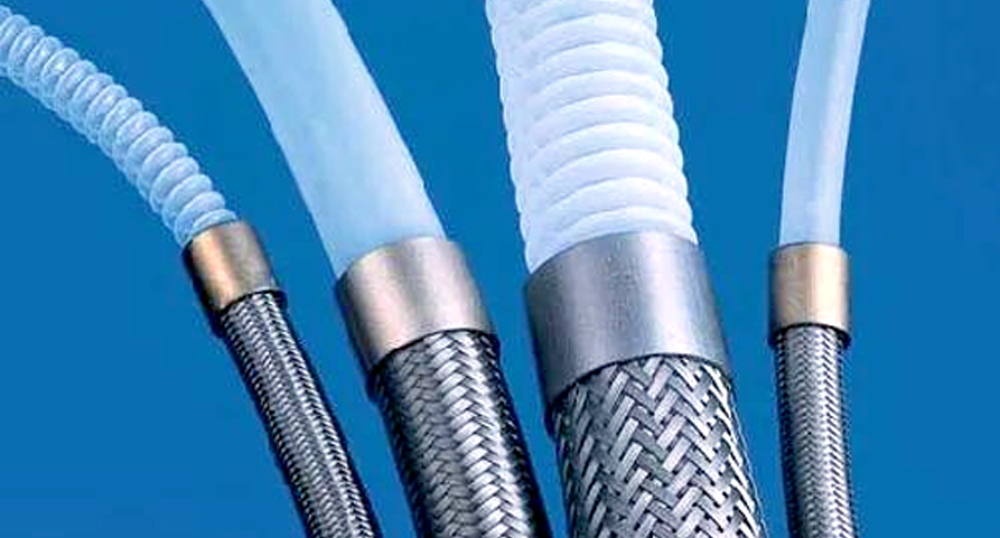
1. What is PTFE tubing?
Polytetrafluoroethylene (PTFE), abbreviated as PTFE, is a high-molecular compound synthesized by polymerizing tetrafluoroethylene monomers, with the molecular formula (CF₄)ₙ. Its main molecular chain consists of a carbon backbone completely surrounded by fluorine atoms, forming a symmetrical structure. The C-F bond energy reaches up to 466 kJ/mol, giving the material exceptional chemical stability. At room temperature, it appears as a milky white or semi-transparent waxy solid with a density of 2.2 g/cm³ and a water absorption rate below 0.01%.
2. Manufacturing Process of PTFE Tubing
PTFE tubing has a continuous operating temperature range of -80℃ to 260℃, with short-term tolerance up to 300℃. It features a friction coefficient as low as 0.04—the lowest among known plastics—and possesses the non-polar characteristics typical of perfluorocarbon materials, demonstrating absolute inertness to over 98% of chemical reagents, including concentrated sulfuric acid and aqua regia. Its dielectric strength exceeds 45 kV/mm, volume resistivity surpasses 10¹⁷Ω·m, and performance degradation remains under 3% after 5,000 hours of ultraviolet exposure.
3. Core Properties of PTFE Tubing
PTFE tubing operates continuously within a temperature range of -80℃ to 260℃, with short-term peak tolerance reaching 300℃. Its friction coefficient is only 0.04—the lowest among all known plastics—combined with the non-polar nature of perfluorocarbon materials, ensuring complete chemical inertness to more than 98% of chemical reagents, including concentrated sulfuric acid and aqua regia. It offers a dielectric strength of ≥45 kV/mm, a volume resistivity exceeding 10¹⁷ Ω·m, and less than 3% performance degradation after 5,000 hours of UV exposure.
4. Applications of PTFE Tubes
In the chemical industry, PTFE tubes are the preferred material for conveying highly corrosive media and are commonly used as lining layers in pipelines carrying concentrated hydrochloric acid, hydrofluoric acid, and similar substances. In mechanical engineering, their low-friction properties make them ideal for manufacturing oil-free bearings and hydraulic seals, enabling maintenance-free operation over long periods—such as in roller shafts of paper-making machinery. In the medical field, PTFE tubes certified for biocompatibility have been applied in implantable devices such as artificial blood vessels and drug-eluting catheters, demonstrating clinical stability exceeding 10 years in coronary bypass surgeries.
5. Types of PTFE Tubes
Depending on application requirements, PTFE tubes can be categorized into standard straight tubes, braided-reinforced tubes, and heat-shrink tubing. Standard straight tubes are suitable for general conveying applications; braided-reinforced tubes, strengthened with steel wires or fibers, offer improved pressure resistance; while heat-shrink tubing utilizes PTFE's thermal contraction property, making it ideal for cable protection and sealing.